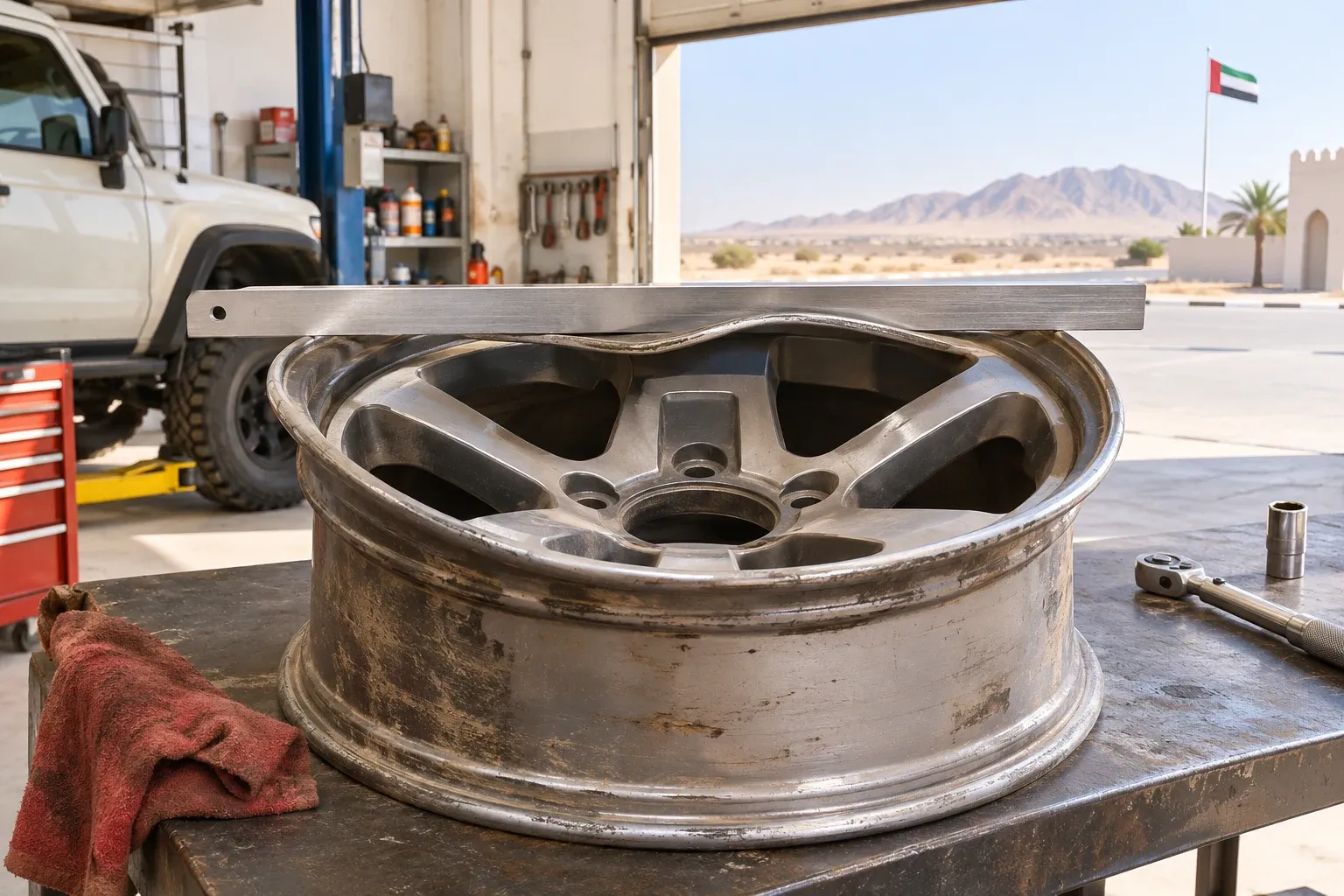
A bent rim can often be straightened if the bend is moderate and there are no cracks. A cracked rim, a heavily kinked one or a badly corroded bead seat should be replaced. Always have a technician measure the wheel on a machine before deciding.
Hard kerbs, rocky wadi tracks and potholes bend wheels every week. Here is how I decide whether a rim is worth saving, and what the repair involves.
How rims get bent
- Kerb strikes in car parks and on tight turns in Deira, Sharjah and Abu Dhabi streets.
- Potholes and road edges where a drain or a broken surface catches the wheel.
- Rock impacts on mountain tracks and in wadis, especially at low tyre pressure.
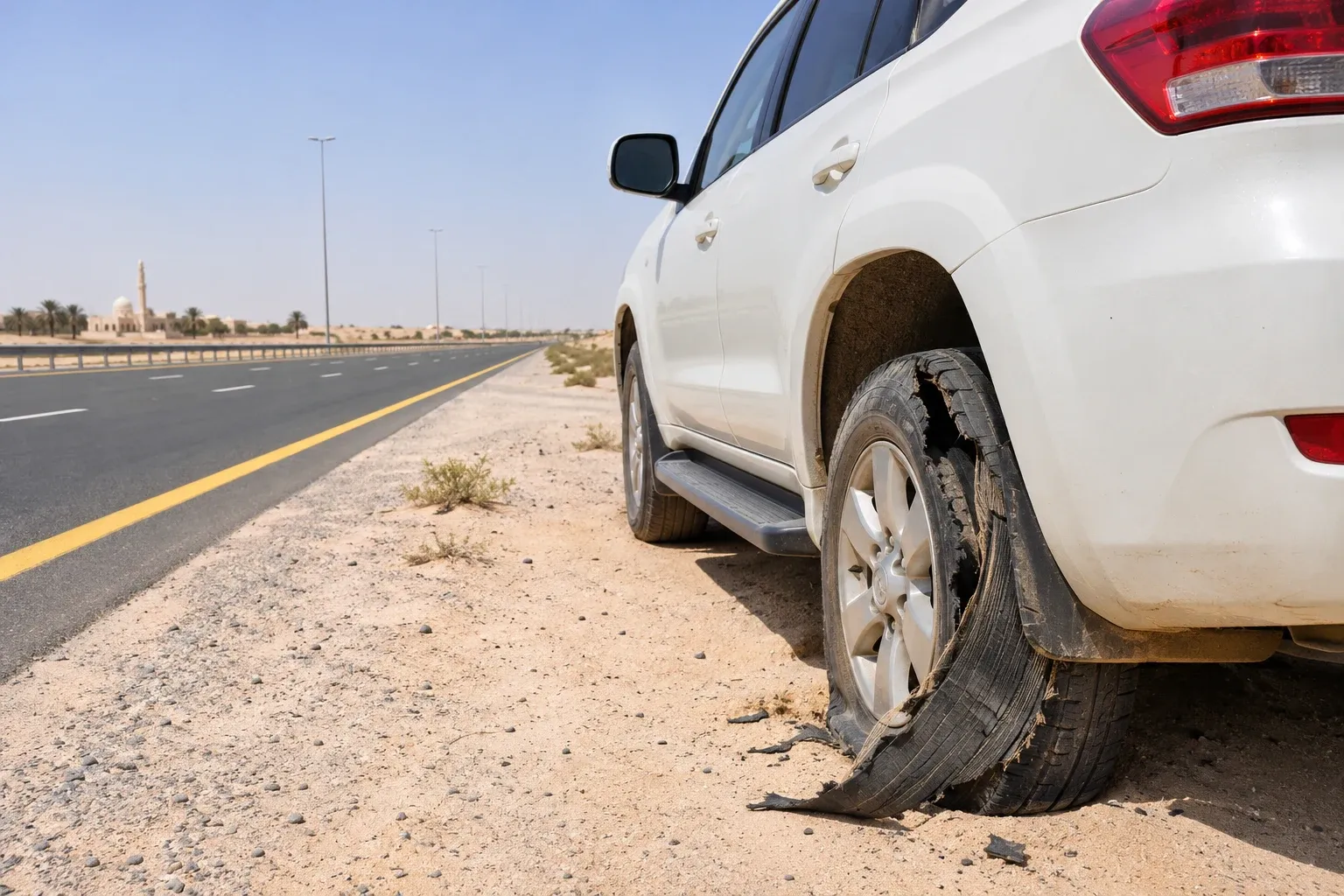
- Driving on a flat tyre, which puts the rim directly on the road.
- Heavy landings after a dune drop.
Low pressure raises the risk, because the tyre no longer cushions the rim. Our guide to wadi driving tyres explains why rocky tracks call for a higher pressure.
Signs of a bent or damaged rim
- Steering wheel vibration at certain speeds that returns after balancing.
- A tyre that keeps losing air from the bead area.
- Visible wobble when the wheel is spun on a balancer.
- A flat spot or dent on the rim lip.
- Uneven tyre wear on one tyre only.
- A pull to one side after a hard hit.
A leak at the bead often means the rim lip is bent enough that the tyre no longer seals. Sand can also cause this, as I describe in sand in the tyre bead, so cleaning comes first.
What I check
When a wheel comes in, I do a step-by-step inspection.
- Remove the tyre and clean the rim thoroughly.
- Spin the rim on a balancing or truing machine and measure radial and lateral runout.
- Look for cracks, especially at the spokes, hub and bead seat. I use a bright light and sometimes a dye penetrant.
- Check the bead seat for corrosion, pitting and dents.
- Check the hub bore and bolt holes for wear.
- Decide: straighten, refinish or replace.
If the rim is out by a small amount, straightening is likely to work. If it is out by a lot, the metal may already be stressed.
What can and cannot be repaired
| Damage | Repair possible? |
|---|---|
| Light to moderate bend on lip or barrel | Usually yes |
| Dented bead seat | Often, if smooth after repair |
| Surface scratches and kerb rash | Yes, cosmetic refinishing |
| Cracks in any part | No, replace |
| Severe bend or kinks | Usually no |
| Heavy corrosion on bead seat | Sometimes, depending on depth |
| Bent steel wheel | Often yes, if no cracks |
I do not weld cracked alloy rims for road use. A weld changes how the metal behaves, and a rim that fails at speed endangers everyone nearby.
How straightening works
For alloy rims, the wheel is held on a machine and heated carefully while pressure reshapes the bend. The technician checks the runout again and repeats until it is within tolerance. Overheating weakens alloy, so skill matters. For steel rims, cold pressing is often enough.
Afterwards the wheel is cleaned, checked for cracks again, and the tyre is refitted, balanced and tested. A proper wheel balancing from AED 120 for four wheels confirms the repair. If the bend caused uneven tyre wear, an alignment check is wise. See uneven tyre wear patterns.
Cost and time
Our rim repair starts from AED 220 per rim. The price moves with rim size, the severity of the damage and if you also want a cosmetic finish as well. A mobile call-out is not suitable for most rim work, since the machine is in the workshop in Al Quoz Industrial Area 3, Dubai. Bring the wheel in or have the vehicle recovered to us.
Compare that with the cost of a new rim and a new tyre if the old one was damaged. For some premium wheels a repair is clearly cheaper. For a basic steel wheel, replacement can be similar in price.
Should I repair or replace?
Repair makes sense when:
- The damage is a modest bend with no cracks.
- The rim is a common or expensive design.
- The bead seat is still smooth and sound.
Replace when:
- Any crack is present.
- The rim has been bent more than once.
- The corrosion is deep.
- The wheel is a cheap steel design that costs little to replace.
- The rim is badly kinked or has lost shape.
If you are unsure, I will explain the reason. I would rather sell you a new rim than repair one I do not trust.
The tyre on a bent rim
A tyre that has run on a bent rim can be damaged too. The sidewall might have a hidden bruise or crease. If the tyre was driven flat, I do not repair it without an internal inspection, and sidewall or shoulder damage is never repairable. Often the tyre must go. A tyre inspection from AED 50 per vehicle checks all of this.
Preventing rim damage
- Keep pressure correct. Low tyres leave the rim exposed.
- Drive slowly over rough ground and watch for edges.
- Avoid kerbs, particularly on lower-profile tyres.
- Choose a tyre with a sensible sidewall height for your driving. Our post on fitting bigger tyres covers what rim size and sidewall do.
- Check rims after a hard hit, even when the tyre seems fine.
A typical example
A driver of a Patrol hits a pothole on a service road outside the city and notices a steering vibration at around 100 km/h. They go to a quick tyre stop that balances the wheels, but the shake returns within days. By the time they come to us, the rim lip on the front left is visibly out of true, and the tyre has begun to wear on the inner shoulder.
On the machine the runout is outside tolerance, but the metal is sound and there are no cracks around the spokes. We straighten the rim, refit the tyre with new valve stem and balance. The vibration goes, and the tyre wear stops progressing.
Contrast that with a different case, where a rim has a hairline crack near a spoke from an earlier impact. No amount of straightening makes that safe. That wheel gets replaced, and I explain why.
The point is that the same symptom can have two very different answers. A vibration after an impact deserves a proper look on a machine, not a repeat balance. Bring the wheel in early and the repair is usually simple, and it protects the tyre and suspension in the meantime.
What to do right after a hit
Stop, look, and do not continue if the steering feels wrong. Check the tyre for a bulge or a flat. Take a photo of the damage. If the vehicle drives straight and the tyre holds air, drive gently to a workshop. Do not ignore a vibration, since a bent rim hurts bearings and suspension over time.
A bent rim is a repair job in most cases, not a disaster. Bring it to us and we will measure it before we say anything.